Monday, May 10, 2010

Transitions in the Opening Scene Sequences of Citizen Kane (1941)

Citizen Kane movie poster found on blog.phillynews.com
The transitions used in the scene sequences of the opening of Citizen Kane were truly remarkable, and many were used in such a short span of time. Firstly, Citizen Kane opens with a fade in of a close up shot of a no trespassing sign. Then, as the camera moves up the fence bordering Xanadu, Kane’s pleasure retreat, dissolves are utilized showing the various designs that were put into the fencing. The camera moves further and further up the fence until it reaches the top where it reveals Kane’s castle in the far distance. Dissolves continue to reveal long shot after long shot, showing the various plants and animals that live around Kane’s Castle at Xanadu. Then dissolves move the camera closer as it reveals a close up shot of the window of Kane’s sleeping quarters. Yet another dissolve moves the camera inside the room, and shots continue to dissolve revealing a snowy night sky followed by a fake house inside a snow globe. As the camera dissolves in and out ominous sounds are played in the background, intensifying the feeling that something unsavory is about to occur. The shots are also of the grounds and castle at night, adding to the foreboding. The scene cuts from the snow globe to Kane’s lips in a rather dramatic fashion, dramatizing the word rosebud that then issues from his lips. Cutting shots continue showing the snow globe rolling down the small set of stairs bordering Kane’s bed. Then the scene cuts to the snow globe falling off of the last stair and shattering on the ground. As the glass and water fly and land all over the floor, another cut in the shot reveals the nurse entering the room and then approaching Kane’s bed. Dissolving shots then show her picking up his blanket and raising it up over his head. The close up shot then fades out and a shot of the outside window fades in. As that shot fades out the shot of News on the March cuts in. The fade ins and outs are slightly quiet and calming as if not to reveal too much to the viewer, and then the cut in of News on the March is startling to the viewer as it is much louder than the previous scene. The words News on the March fade in and out and then numerous cuts occur as quotes about Kane and Xanadu move in and out of the shot. The cuts continue with few dissolves until the art and architecture of Xanadu is revealed. Wipes then occur from left to right as various forms of sculptures and art are revealed. Wipes continue, also from left to right, as the kinds and amounts of stone that were required to build Xanadu are explained and shown. Cuts then come into the shots as various species of animals are revealed in their confinements throughout the grounds of Xanadu. Continuous fade ins and outs of a quote lead to a cut of Kane’s funeral. The portraying of Xanadu ending as a quote about Kane fades in and out leading to the explanation of his business practices. Throughout the opening scene and the scene about Xanadu following the scene sequence employs fade-ins, fade-outs, dissolves, cuts, and wipes delivering a great deal of information about Xanadu and Kane in exquisite fashion. The transitions build up the dramatic response in the audience by being fast paced and thought provoking just as the actions and words of Charles Foster Kane.
Works Cited
"Citizen Kane (1941)." The Internet Movie Database (IMDb). Web. 7 May 2010. .
Citizen Kane. By Orson Welles. Dir. Orson Welles. Prod. Orson Welles. Screenplay by Herman J. Mankiewicz. Perf. Orson Welles, Joseph Cotten, Dorothy Comingore, Agnes Moorehead, Ruth Warrick, Ray Collins, Erskine Sanford, Everett Sloane, William Alland, Paul Stewart, George Coulouris, Nova Fortunio Bona, Gus Schilling, Zandt Philip. Van, Harry Shannon, and Alan Ladd. Distributed by RKO Radio Pictures, Inc., 1941.
Corrigan, Timothy, and Patricia White. The Film Experience: an Introduction. Boston: Bedford/St. Martin's, 2009. Print

Post War Cinema, Diegetics, and Character Development in 3:10 tu Yuma (2007)

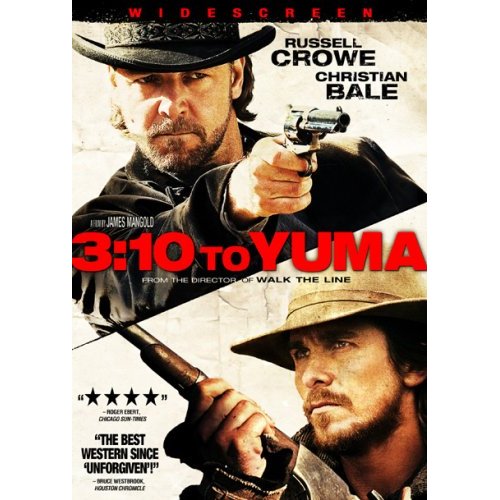
3:10 to Yuma poster found on yahoo movies
The cinematic elements of 3:10 to Yuma have made it one of the best westerns of all time, griping the audience and allowing them to see the humanistic side of the characters while still experiencing cinematic excellence. The post civil war setting of the film has made it a great addition to the post war cinema genre. Also, diegetic and nondiegetic elements play a large role in the historical setting of the movie. In addition to these two things, character development allows the audience to see the improvement, or lack thereof, of the character’s social complexities and responses to their surroundings. 3:10 to Yuma contains many different cinematic elements that enrich the viewing experience and allow the audience to experience historical elements, character development, and diegetic elements.
3:10 to Yuma is an excellent addition to the post war cinema genre and reveals the aftermath of a devastating civil war. The story takes place after the civil war and the plot surrounds a civil war vet that lost his leg during the war. Also, a major aspect of the plot is the destruction the building of a railroad would be to the main character’s home and land. The railroads being built are the very things that were to connect a post civil war torn America. In addition, Dan Evans, portrayed by Christian Bale, is going through the middle of a financial crisis that is causing complications for his family. A common element of post war times is the lack of financial prosperity due to the money poured into wars. The subtle historical elements of the film enrich the setting as well as the character interaction in the story.
Diegetic and Nondiegetic elements both play a role in the story of 3:10 to Yuma. Firstly, one of the diegetic elements included is the building of the railroads. A lot of railroad construction occurred in that time period and the affects the building would have on Dan’s family make it directly related to the story. Another diegetic element is that of the 3:10 train to Yuma. Its direct relation to the main focus of the film makes it diegetic, which focuses on transporting Ben Wade, played by Russell Crow, to the prison in Yuma. In contrast, a nondiegetic element of the film is the historical element of the Civil War. Although Dan was maimed in the Civil War, the war is not a main focus of the story of 3:10 to Yuma. These elements bring the historical aspect of the story to life.
The main character’s character development plays a large role in conveying the social changes of Dan, William, and Ben Wade throughout the film. Dan Evans goes through a slightly internal regression. This is evident when we see the change from a cautious man to a brave and courageous fighter. In the beginning of the film he tells his son that he needs to choose his battles and cannot always go in with guns blazing. By the end, when all seems to be lost, he will not give up the fight and he does absolutely anything to get Ben Wade to the train. A reverse change occurs within William Evans. In the beginning he calls his father a coward for not shooting Ben Wade in the first place. When he discovers that there is a slim chance to get Wade to the train, he quickly tries to talk his father out of the job. This change is internal and regressive. Ben Wade’s social transformation is the same as Dan Evans in the way that it is internal and progressive. In the beginning he will do anything to avoid prison, but when he discovers that Dan secretly desires his son’s approval, he will do anything to make sure that Dan gets him to the train and gains his son’s acceptance. He puts his own desires aside to help a man with the life he wished he could have. The character development in 3:10 to Yuma is profound and exhibits many unexpected changes in the main characters.
3:10 to Yuma is comprised of many cinematic elements that are essential in the creation of a cinematic masterpiece. The post civil war setting makes it a great addition to the post war cinematic genre. Also, the execution of diegetic and nondiegetic elements enrich the story and plot allowing the audience to come extremely close to experiencing life in that time. Finally, the character development is astounding in the way that it details the social change from cowardice to bravery and vice versa. 3:10 to Yuma is sure to be an addition to the western genre that stands the test of time for many years to come.
Works Cited
"3:10 to Yuma (2007)." The Internet Movie Database (IMDb). Web. 7 May 2010. .
3:10 to Yuma. Dir. James Mangold. Perf. Russell Crowe, Christian Bale, Logan Lerman, Ben Foster, and Peter Fonda. A.V.H., 2007.
Corrigan, Timothy, and Patricia White. The Film Experience: an Introduction. Boston: Bedford/St. Martin's, 2009. Print.

Transitions, Continuity, and Verisimilitude in the Editing of The Best Years of Our Lives (1946)

Editing within The Best Years of Our Lives was truly remarkable when considering the affect it had on the audience’s vision of the cinematic excellence of the film. Firstly, the transitions used within the film provided easily viewed shifts from scene to scene as well as continuity within the sequences within the scene. Also, the axis of action and the one hundred and eighty degree rule are clearly evident in the editing continuity of the film. Finally, verisimilitude is implemented into several of the opening scenes of the film, intensifying spatial and time realism. Wyler’s The Best Years of Our Lives contains a vast amount of editing techniques, most noticed of which are the transitions, continuity in editing, and verisimilitude.
The primary transition present throughout the film The Best Years of Our Lives is that of dissolving from one scene to another. This transition is first seen in the very first opening scene in which Fred picks up his bags off the floor of the airport and walks towards the ticket podium. A long shot shows him approaching the podium and then a dissolving transition shifts the scene to him standing at the podium and conversing with the women standing behind it. Also, dissolving is used when the women tells Fred that he could try the ATC, which finds veterans flights home. As the gentle men steps in from the side to pay his excess baggage fee, the scene dissolves from inside the airport to the outside plane that Fred is walking under to get to the ATC. Finally dissolving is implemented in the scene shift between Fred’s walking towards the ATC and finally being at the desk inside the ATC. A widening shot reveals Fred getting closer to the entrance, and then dissolving leads to a mid-range shot of Fred standing at the desk, waiting for a flight that could take him home. Dissolving is heavily relied upon during scene shifts within The Best Years of Our Lives.
Continuity in editing is present in much of the film through the implementation of the one hundred and eighty degree rule. It is first seen in the scene in which Homer is sitting in the living room with his and Wilma’s family. Alternating shots reveal homer conversing about tobacco, then Mrs. Cameron questioning him, and finally him responding to her questioning. The axis of action lies on Homer and Mrs. Cameron. Also, the one hundred and eighty degree rule is used in the same scene in the dialog between Homer’s little sister and his father. That time however the axis of action fell on Homer’s sister and father with alternating shots as they spoke. Finally, the same rule is implemented in Al’s first conversation with Mr. Milton. The axis of action lies on Mr. Milton sitting behind his desk, and upon Al sitting in a chair of to the side. Alternating mid-range shots show the two conversing back and forth. The alternating shots where assembled in a continuing fashion that allows the audience to follow conversation with less confusion.
Scene sequences are helped along greatly by the verisimilitude used making spatial and time realism present in many scenes. It is seen in one of the first scenes in which Fred runs to the desk in the ATC. A long shot shows him running towards the desk, and then the scene cuts to a closer shot of him from behind the desk. It is similarly shown a bit later when Homer and Fred are walking towards the plane their taking home. A wide shot on them walking towards the plane and then a closer shot from inside the plane just as they enter. Finally, verisimilitude is expressed when Homer is approaching Butch’s for the first time since he has been back from the war. A long shot is revealed of him walking towards the entrance and a cut to the inside of Butch’s occurs just before he enters, timing is perfect and reinforces spatial and time realism through the timing and course of action. The use of verisimilitude makes the impression on the audience that the events of the film are occurring as they watch the film, bringing the viewer deeper in to the cinematic experience.
The editing used in The Best Years of Our Lives was expertly expressed in the amazing scene sequences, continuity, and verisimilitude utilized. The dissolving transition used in most of the film allowed an ease of fluidity that sowed together every scene. The viewer was easily able to follow the course of events from scene to scene. Also, continuity in editing allows viewers to follow the dialog within the film easily with great execution of the one hundred and eighty degree rule. In addition to these two things, verisimilitude allows spatial and time realism to reel the audience into the film, allowing them to feel as though they were in the story experiencing live events. Wyler’s The Best Years of Our Lives utilized many great editing techniques that allowed the audience to get lost in the complexities of the lives of three heroes returning from the battle front.
Works Cited
"The Best Years of Our Lives (1946)." The Internet Movie Database (IMDB). Web. 7 May 2010. .
The Best Years of Our Lives. Dir. William Wyler. Prod. Samuel Goldwyn. By Robert E. Sherwood. Perf. Myrna Loy, Fredric March, Dana Andrews, Teresa Wright, Virginia Mayo, Cathy O'Donnell, Hoagy Carmichael, and Harold Russell. RKO Radio Pictures, Inc., 1946.
Corrigan, Timothy, and Patricia White. The Film Experience: an Introduction. Boston: Bedford/St. Martin's, 2009. Print.

Friday, May 7, 2010

Conventions, Archetypes, and Genres of The Seventh Seal (1957)

There are a vast amount of conventions, archetypes, and genres contained within the cinematic masterpiece that is The Seventh Seal. A generic convention that is clearly evident within this particular film is that of iconography, particularly seen in the settings of The Seventh Seal. In addition to this, one genre that could be considered while analyzing the film could be a hybrid genre of historical, philosophical, and melodramatic aspects. Finally, social archetypes abound in a plot surrounding death and the pursuit of freedom from it. Bergman’s The Seventh Seal is a truly remarkable film that highlights the audience’s feelings of death, and a monumental question of the existence of god.
Iconography comes out in the settings and props of The Seventh Seal, representing many connotations and meanings. Firstly, a major aspect of the film is the game of chess in which Death and the crusader are intensely wound up in. The mere game itself is a symbol that intensifies the battle of wit, cunning, and power. The crusader and Death are constantly combating each other mentally. When being questioned on the existence of God, Death chooses not to answer the crusader. He chooses his moves carefully, instead warning him that nothing ever escapes him, and sooner or later he gets what he wants. Also, the crusader encounters death in vastly open areas such as beaches and fields. They’re settings that intensify the underlying questions of the film, and the unlimited space for complex answers. Finally, the setting of the forest, within the middle of the film, intensifies the emotional complexities that come with the coping of no control over death. When the black plague consumes the actor’s pursuer in front of the traveling group, they must simply turn away and leave him, for it may be their fate if they help him. The setting of the dense forest reveals the tightening grip of death upon the travelers. This simple convention, present in all films, is the most crucial when setting the scene for a plot centering on any genre.
The complex genres contained within The Seventh Seal have created their own historical, philosophical, and melodramatic genre. The historical aspect of the genre comes into play with the story being set during the epidemic of the black plague. Another historical aspect involved is the main character’s role in the crusades. The philosophical niche of the genre is evident in the pondering of the question of the existence of God. More importantly, the consideration of cheating death and extending life becomes a main focus of the plot and story. This is evident in Joseph’s attempt to distract death while the actor’s family flees the forest, which is done by Joseph’s flipping of the chess board. Lastly, melodramatic elements enter the story through the character’s interactions and reactions towards death. The young woman, who remains silent throughout the film, is drastically affected by the death of the actor’s pursuer. It is also present when death kills the man in the tree, who screams and reacts with immense fear at death’s actions. Bergman creates his own hybrid genre in this addition to cinematic history.
Many social archetypes are present in The Seventh Seal that directly relate to the audience watching the film. A main focus of the story line is the concept of family and the role it plays in our lives. The crusader is desperately trying to avoid death and make it safely home to his wife. The family model is also present in the actor’s family’s role in the film. Joseph risks everything, even angering death, to ensure that his family, and more importantly the actor’s baby, gets away. In addition, the bonds of friendship and loyalty come into play within the relationship of the squire and the crusader. They are contrasting characters that reveal the drastic difference in the tragedies of experience, in the knight, and the innocence of apprenticeship, in the squire. Finally, the dominant social archetype present in the film is that of the overwhelming presence of death, and the overabundance or lack of faith in God. The social archetypes contained within The Seventh Seal allow the audience to witness their own feelings of death and God on the big screen.
Bergman’s cinematic masterpiece highlights genres that reel in the audience on several deep aspects of the human conscience. It employs iconography in an exquisite fashion that intensifies the actions and emotions surrounding death and the question of the existence of God. Also, it creates a hybrid genre riddled with historical, melodramatic, and philosophical elements. Finally, many social archetypes allow the audience to directly relate to the characters and their interactions with death. Although it may be in black and white, the seventh seal displays a rainbow depicting the spectrum of human emotion in life and death.

Works Cited
Corrigan, Timothy, and Patricia White. The Film Experience: an Introduction. Boston: Bedford/St. Martin's, 2009. Print.
"Det Sjunde Inseglet(The Seventh Seal) (1957)." The Internet Movie Database (IMDb). Web. 08 May 2010. .

Monday, May 3, 2010

Mise-en-Scene in A Streetcar Named Desire (1951)

The Mise-en-Scene is crucial for the audience to find themselves lost in a motion picture. The Mise-en-Scene in A Streetcar Named Desire is a perfect example of the influence the environment within the film can have on the expression of the characters thoughts, emotions, and actions. Firstly, the film contains a vast amount of instrumental and metaphorical props that provide great insight into the characters and themes of the film. An instrumental prop of the film is Blanche’s, portrayed by Vivien Leigh, traveling trunk, which holds all of her possessions. She frequently digs through her trunk throughout the scenes held within the apartment, withdrawing from it her various dresses, scarves, and pieces of jewelry. A metaphorical prop within the movie is the Chinese lamp shade Blanche purchases and puts over the light bulb in her room. It represents the dark veil her lies places over all of the character’s faces. When Stanley, played by Marlon Brando, rips the shade from the lamp, it reveals Blanche’s face, allowing him to see how old she truly is. Stanley’s revealing of the light is a metaphorical representation of the light truth can bring. It also reveals that, like light, the truth always finds a way to shine through the darkness of lies and deceit. Secondly, another aspect of Mise-en-Scene in the film is the balancing of the perspectives of the main characters, which can only be done through the types of actors in the movie. Blanche is provocative, manipulative, and self conscious. Her sister Stella, played by Kim Hunter, is more confident, caring, and submissive. The contrast to Stanley is Mitch, portrayed by Karl Malden. Where Stanley is dominant, abusive, and dismissive of Blanche’s worries, Mitch is caring, gentlemanlike, and accepting of Blanche. It is only when her lies are revealed that Mitch falls out of love with her. Finally, the Mise-en-Scene as a measure of character within A Streetcar Named Desire is astounding. When Stanley and Stella’s apartment suddenly has a third inhabitant it becomes claustrophobic and cluttered. The apartment is a measure of the narrow minded Stanley, who has no idea how to treat a lady, and is only concerned with his own needs. He has no concept of an open mind in which an individual empathizes with other people, or in this case other characters. In a direct contrast, Mitch and Blanche’s most intimate conversation is held on a pier like location with open air, sea, and restaurant inhabitants detailing the environment. The setting is a measure of Blanche and Mitch’s open mind towards one another, and their desire to get to know and be with each other. The setting represents the potential for their love to continue to grow and develop unstrained. The Mise-en-Scene contributes greatly to the outcome of a motion picture. Through props, settings, and actor types, the audience is given a gateway into a world that provides an escape from the complexities of everyday life. In A Streetcar Named Desire, the Mise-en-Scene allows the audience to view the actors not only as characters, but as people they can relate to.

Thursday, March 11, 2010

Confronted Assumptions and Altered Opinions of Loose Change

The controversial documentary film Loose Change attacks the ideal of the terrorist attacks of 9/11, focusing on the concept surrounding the united state government’s potential role in the “terrorist” attacks. First of all, the documentary confronts the American citizens’ assumption that the attacks on September eleventh were solely a result of brutal terrorism. Also, this documentary tries in great detail to alter the American citizens’ opinions of their government. Finally, it is an overwhelming attempt to get a raise out of the American people and motivate them to act and question the practices and actions of the American government. Loose Change attempts to make the audience re-comprehend the events of September eleventh and open their eyes to the director’s ideas of government conspiracy.
The automatic assumption of the American citizens was that the attacks on September 11th 2001, were a result of terrorists actions and that we must combat such actions with a war on terror. Firstly, Loose Change attempts to have the audience view the terrorist attacks as a result of our own government’s actions and provides “facts” that support an idea that it was an attack on our country by our own government. Also, it pick’s apart our government’s actions afterwards and forces the audience to look deeper into the government’s ability to react to terrorizing and difficult situations that have a large impact on the entire country. In addition to these two things, Loose Change exploits the government’s inability to provide the American public with valid and detailed information regarding events that impacted thousands of lives. As with many other nation impacting events, such as hurricane Katrina, this documentary reveals to the audience the flaws in our government and especially illuminates the government’s inability to respond quickly to destructive events.
Loose Change’s attempt to motivate the American population into questioning the actions of our government in response to the terrorist attacks is a crucial defining concept of a documentary. They lead us to question response time when they bring up the topic of the army’s fighter jet’s inability to respond and intercept the hijacked flights. Also, they highlight the government’s poor security by revealing the information regarding the terrorist’s location in the United States prior to the attacks on September eleventh. Finally, they force us to question the government’s involvement when they reveal the benefits our government would gain with a war on terror, as it gives them reason to investigate any citizen for any reason that could lead to terrorism. Getting the American people to question government action could arguably be the main focus point of the documentary Loose Change.
The creation of a documentary is a result of one thing, the desire to force the audience to think of another point of view that is most likely different from their own, and this is done by Loose Change. It opens the American public’s eyes to the government’s actions surrounding September eleventh. Also, it attempts to change our opinions of those responsible for the terrorist attacks. Lastly, it motivates the American people to entertain the idea that the events of the last nine years are a result of our own government’s bid to gain control of our simplest freedoms and plunge us into a “war on terrorism” that gives our nation direct access to the natural resources of the countries in the Middle East. Loose Change may challenge the pride citizens have in our nation, but it provides insight into a very believable theory of the events of September 11th 2001.

Wednesday, March 10, 2010

Narrative across Culture: Age Groups of Gamorra

The heart pounding Gomorra, directed by Matteo Garrone, plunges the audience into an unbelievably in depth and deep insight into the heart of organized crime in Italy. One of the most visible aspects of the life of organized crime was the difference among age groups involved in organized crime in Italy. The youngest life influenced by crime was that of Toto, portrayed by Salvatore Abruzzese. Also, Marco and Ciro, portrayed by both Marco Macor and Ciro Petrone respectively, are two teens that become so enveloped in the mob that they lose their lives. Finally, Roberto, played by Carmine Paternoster, has to quit his job in order to avoid the devastating destructive force of the mob. Garrone’s Gomorra is a truly remarkable piece of cinematic history that defines the differences of age groups within the Italian mob with great detail.
A thirteen year old boy by the name of Toto becomes entangled in a gang that essentially forces him to walk the line between boy and man. Firstly, Toto is constantly trying to prove himself a man, as all young boys across all cultures do. Also, his workings with the gang involve him with the dealing of drugs along with the use of weapons that his mother says was the life of his father, and she wouldn’t let him follow in that path. Finally, although he greatly desired to be treated like a man and part of the gang, when the much older gang members asked him to kill Maria out of revenge, he is hesitant to complete the very act that will prove him worthy of manhood and the gang. Garrone allows the audience to see the terrifying effect the mob has on the life of even the youngest of adolescence.
Garrone’s cinematic masterpiece also follows two teens, Marco and Ciro, as they attempt to make their mark on the territory already claimed by the Camorra. They are desperate to prove that they are badasses and can do whatever they want whenever they want, without consequences. This brings them to the attention of the Camorra, whom has a tight grip on organized crime in Italy. They become extremely annoyed by the two’s inexperience, immaturity and lack of respect with regards to the way they act, holding up places where people are all over and their theft of the Camorra’s weapons. Although they speak of the teens’ immaturity and inexperience, instead of showing them the ropes or giving them a chance to prove themselves, the Camorra wipes them out. For people who profess to have great experience and maturity when considering “business”, they completely ignore the fact that the teens are inexperienced due to the fact that they are just starting out in the “business.”
Roberto is a recent graduate of college who works in a toxic waste management organization that is backed by the mob. His boss does whatever he can to ensure that the job is complete and money continues to flow. This includes opening up more waste sites for dumping regardless of its harmless effects on those living around the sites. The choices of his boss eventually lead to his quitting when he decides that he has had enough of the dumping. A mere college graduate decides to take the course of his life back into his own hands as he walks away from his boss. Although it is difficult for him to do so, Roberto’s attempt to lead an honest and strait path brings him to abandon the job that made him who he was. The organized crime even affects those attempting to better themselves with a higher education, and corrupts lives of all ages.
Garrone’s Gomorra is a perfect visual account of the mob’s ability to infect all ages of life. It takes over the lives of children, as seen in Toto’s struggle with maturity as he is forced to lure his friend’s mother to her death. Also, it is apparent in the lives of teens as Marco and Ciro attempt to make quick cash as they try to immerse themselves in the lifestyles of the mob. Finally, it is evident in young adult’s lives through Roberto’s challenge to take hold of his life and walk a path different from that of the life of crime. Gomorra, although it may be dark, beautifully reveals the affects of the mob against different age groups making it an amazing example of narrative across culture.


Works Cited
"Gomorra (2008)." The Internet Movie Database (IMDb). Web. 11 Mar. 2010. .
Gomorra. Dir. Matteo Garrone. Perf. Salvatore Abruzzese, Marco Macor, Ciro Petrone, and Carmine Paternoster. 2008. DVD.

Saturday, February 27, 2010

Mullholland Dr.

David Lynch’s Mulholland Dr. is a cinematic rollercoaster ride that unveils the true darkness and complexities of Hollywood, and its sometimes traumatic influence on even the brightest and cleanest young women that pursue stardom under its bright city lights. Firstly, it reveals to the audience the terrible truth that lies in the need to know people in high positions to get a head in show biz. Also, it unveils the traumatic influence the pursuit of a dream, can have on a young women. Finally, the amnesia that over takes an actress is symbolic of the veil that is pulled over an individual entering Hollywood and the transitions they undergo as they follow their dream. Mulholland Dr. allows audiences everywhere an insight into the void of Hollywood and its influence on many.
One aspect of the chaotic plot line contained within Mulholland Dr. is a young director’s determination to control the actors that are placed within his movie. This becomes a challenge when he is told that he must put an actress by the name of Camilla Rhodes in his film. Despite his interest in several other actresses that he would like to consider for the part, he is forced to use Camilla if he wishes to continue to make the film. The mob’s influence on the studio creating the project shows the audience the complexity involved in knowing the right people to advance in the business. When considering a job in Hollywood, how far you get is based on who you know, and where they can get you.
A young actress by the name of Dianne Selwyn undergoes a change of psyche when she becomes enveloped in the life of a struggling Hollywood actress. The darkness of Hollywood causes her to become schizophrenic, and create a bizarre reality where she is the star of a real life adventure, and her dream of being an actress is an easy accomplishment. She also becomes unbelievably manipulative, and relies on a love connection with Camilla Rhodes to get into a few small roles in Camilla’s movies. She then turns on Camilla when Camilla falls for the director and tells her that their romance has to stop. When the thought of losing her only break approaches her, she turns murderous and before she can hire someone to take out Camilla she is destroyed by her own mental issues.
When “Rita” is the victim of a car accident she is overcome by an overwhelming amnesia that catapults her on a journey to discover her identity and role in a bizarre grouping of a bag of cash, a strange blue key, and a mysterious club. Her amnesia and journey are symbolic of the veil that a glamorous life can pull over an individual’s eyes. Hollywood gives any who try the slim chance of becoming a star. This taste of stardom changes all and puts them on a path towards changing themselves to become mirror images of society’s perfect people. Rita’s very amnesia is a symbol of the way individuals can forget who they truly are in the pursuit of stardom, while they whittle themselves into society’s perfect image of beach bodies and spray tans.
David Lynch’s Mulholland Dr., is a cinematic masterpiece that allows all audiences to see the complexities and struggles within the life of an aspiring actor. The only way to advance in show business is to know the right people who can get you the right roles. Also, the amnesia that overcomes Rita is a perfect symbol of the veil pursuing a career in acting can pull over anyone’s eyes. Finally, the change that transforms Dianne from a clean cut girl into a dangerous falling star is a clear example of the affect the Hollywood life can have on people. Mulholland Dr. could easily be seen as Lynch’s warning to anyone entering the business, beware of the roles you put on to get ahead, because it just may cost you your identity.

Mulholland Dr. Dir. David Lynch. Perf. Naomi Watts, Laura Harring, and Justin Theroux.
Asymmetrical Productions and The Picture Factory, 2001. DVD.

Monday, February 15, 2010

Authorship of a Writer


Although the film theory of authorship is quite frequently related to the director or producer of a project, Kevin Williamson is a screenwriter that clearly makes his mark on every word or line he sows into the scene. First of all, Williamson’s films are nearly always centered on teenagers. Also, his films always follow the teens while they are going through some form of a life struggle. In addition to these two things, Williamson’s films always contain the pivotal moment in which the innocence of the characters is lost. Kevin Williamson’s focus on teenage characters allows him to connect with an audience that is rapidly taking control of the world of pop culture.
Williamson has been extremely successful because he focuses on the same thing project after project, and that is the teenage persona. Firstly, he prays on the fears of teens that are the target of a serial killer in the “Scream” horror series. Also, he took millions of viewers through the tangled and complex minds of growing teens in the popular television drama “Dawson’s Creek”. In addition to these two things, he brings the concept of college and achieving something outside of high school to the screen in “Teaching Mrs. Tingle”. A film who’s antagonist is the fearful Mrs. Tingle, the only thing standing in between the film’s main characters and their futures. These are just a few examples of Williamson’s genius that have made it to the small and large screen.
Kevin Williamson’s screenplays always revolve around the main characters’ life struggles that they either succeed or fail at overcoming. In “Scream”, the main character Sidney Prescott has to face the mysteries of her mother’s past that are causing the death of her friends and loved ones around her. In “Dawson’s Creek”, the main characters must face the challenges of high school and college afterwards. They face emerging hormones and unwavering adolescence while making their various life choices. Finally, in “Teaching Mrs. Tingle”, the main character faces the consequences of a cheating scam while attempting to get into potential colleges, which leads to a confrontation causing her to overcome the teacher bent on keeping her in her small home town for life. Williamson’s screenplays always contain issues that all teens come to grip with at some point on their journey towards adulthood.
Evident in all of Williamson’s works is the crucial moment in a teen’s life when they lose the innocence of childhood. In “Scream”, the unavoidable path Sidney is thrust upon after the death of her mother leads her to the point where she has to face her mother’s killers and in the end kill them. “Dawson’s Creek” finds the loss of its main characters’ innocence through the exploration of their maturity and sexuality. Finally, the main character Leigh Ann Watson losses her innocence when she succumbs to her manipulative teacher and breaks whatever rules necessary to get the A in “Teaching Mrs. Tingle”. In all of Williamson’s works, there comes a time where lives of his characters stop being so “cookie cutter”, and start getting complex.
.

Monday, February 8, 2010

My Film Experience


You are approaching the auditorium, and you are shuddering with the excitement of seeing a new film. After the tearing of a freshly printed ticket fills your ears, you find yourself sitting in a soft cushioned chair as you plunge your hand into a bucket of freshly popped corn. After a rather long reel of upcoming attractions the film begins. Film isn’t just a collection of scenes strung together for the consumer’s entertainment. Film is an experience, and more importantly an escape. It is an opportunity for the audience to feel the ever growing span of human emotion and experience.
Film has provided me with an escape from everyday reality that is essential for anyone encountering a stressful situation or life struggle. They allow you to experience the most luxurious and daring adventure, while showing you how people react to life around them. In addition to adventure, film captures raw human emotion and forces the audience to feel. I first encountered this in Air Bud, the first film I ever saw in a theater. When pairing it with the real-life issue I faced in losing a friend, it revealed to me a character that mirrored everything I was facing. Although I didn’t receive a happy ending reunion in my life, the film gave me the experience of achieving just that. Another film that helped me through a difficult time in my life was The Breakfast Club. When faced with insecurities, it revealed to me that all teens face the dilemma of deciding who they are and where they fit in to the grand scheme of life. Cinema captures everything that drives us in our lives and translates it into fantastic storytelling that transcends the boundaries of all generations.
My absolute favorite genres are action adventure, comedy, and horror. Bruce Willis’s Die Hard series was the best combination of heart pounding suspense and action. More recently the Transformers film series and Avatar have caught my favorite nod. I love comedies such as Billy Madison and Brendan Fraser’s Airheads. However, The Hangover is arguably the best movie from the comedy genre of all time. Last but not least, Wes Craven’s Scream series is my all time favorite horror film series. I love the feeling horror movies provide while sitting in a dark room and having chills move up and down your spine. Growing up, no matter how many times I would change the channel or shut the movie off, I would always go back to the movie and finish it. The suspense, chill, and gore always find a way to pull me back in. Although I could choose several films to take the positions of my favorites of all time, cinema evolves as humanity does, and it is for that reason that I am always looking for a new favorite.